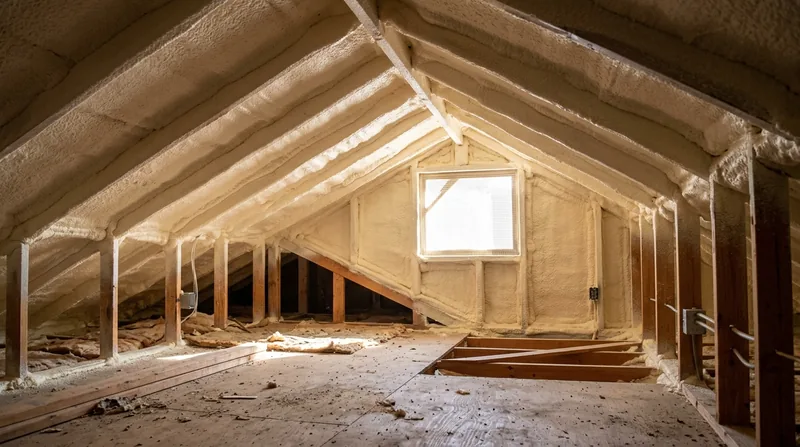




Pueblo's hot summer days and cold winter nights create a relentless cycle of heating and cooling demand that stresses your attic air barrier more than moisture control ever could. Conditioned air escapes through ceiling penetrations, top plates, and rim joists, then outside heat or cold pours back in, driving cooling and heating bills higher every season. Attic spray foam insulation in Pueblo seals those air leaks at the source, closing the gaps that fiberglass batts and blown-in insulation leave behind. We apply closed cell or open cell foam directly to rafters and top plates, creating an unbroken air barrier that stops the stack effect and the temperature swings that dominate the Pueblo County climate. Whether your home sits in Bessemer with an uninsulated rim joist, in Pueblo West with builder-grade batts that have never been sealed, or in the older neighborhoods near downtown where decades of settlement have flattened the original attic insulation, spray foam closes the air leaks that matter most.
Why Attic Air Leaks Cost Pueblo Homeowners More Than Insulation Alone
Pueblo's semi-arid climate and wide day-to-night temperature swings mean air leakage, not moisture, is the enemy. When your attic is vented, insulated with batts, or sealed with blown-in fiberglass, every penetration for electrical, plumbing, and HVAC ducts becomes a direct path for conditioned air to escape. The stack effect pulls warm air up and out through the attic in winter, then draws hot outside air back in through the same holes in summer. Over a heating or cooling season, that air exchange costs far more than the insulation itself prevents, and no amount of R-value in the insulation stops it.
- We identify every ceiling penetration, top plate opening, and rim joist gap that leaks conditioned air year-round.
- Spray foam seals air leaks while it insulates, closing the paths that fiberglass cannot touch.
- A sealed attic stops the stack effect and keeps your HVAC system from working against you.
- Homeowners across Pueblo County report lower cooling bills the first summer and lower heating bills the first winter after foam air sealing.
Getting those leaks closed is the fastest way to lower your energy costs, and spray foam is the only insulation product that does both at once.
Local example: A 1960s ranch in Belmont with original fiberglass in the attic and no air sealing loses conditioned air through ceiling light fixtures, the attic hatch, and unsealed top plates above interior walls. Spray foam applied to the rafters and sealed around all penetrations stops that air leakage and reduces the home's cooling load by 20 to 30 percent, depending on how many leaks existed before.
For guidance on what permits apply to attic work in your city, check with your local building department or call us for a free estimate and we will help you understand what your address requires.
How We Seal and Insulate Pueblo Attics: The Process
Spray foam installation in an attic is a controlled, multi-step process that starts with a site walk-through and ends with a re-entry window you can count on. We assess the attic structure, identify all air leaks and existing insulation, then plan the foam application so thickness and coverage meet code and deliver the R-value your home needs. During the spray, mechanical ventilation runs to manage vapors, and we apply foam in passes that allow proper expansion and cure. After installation, we give you a clear re-entry window of 24 to 48 hours before you occupy the space again.
- We schedule a free on-site estimate and walk your attic to measure square footage and identify all penetrations and leaks.
- We specify the foam type (closed cell or open cell), R-value, and thickness in writing before any work begins.
- We set up mechanical ventilation during the spray to control fumes and ensure proper cure.
- We apply foam to rafters, top plates, around all penetrations, and to rim joists if they are exposed from the attic side.
- We provide a written re-entry timeline and explain what to expect during cure.
The result is an attic that is sealed tight, insulated to code, and ready to stop the air leakage that has been costing you money every season.
Pueblo West example: A newer home with a vented attic and builder-grade fiberglass batts has air leaks around the HVAC ducts, the attic hatch, and the rim joist. We spray closed cell foam to the rafters and seal all penetrations, creating a sealed attic that cuts cooling load in summer and heating loss in winter. The job takes one day, and the homeowner sees lower utility bills within the first billing cycle.
If your attic has old insulation that has settled or failed, we also offer insulation removal before we spray, so the foam adheres to a clean substrate and performs at full capacity.
Attic Spray Foam Insulation Methods: Closed Cell vs. Open Cell
| Approach | Description | Best for |
|---|---|---|
| Closed Cell Spray Foam | High-density foam with a closed-cell structure that resists moisture and air movement. Typical R-value 6.0 to 7.0 per inch. Creates a vapor barrier and structural strength. | Sealed attics, vented attics in high-humidity climates, attics over unconditioned spaces, and any attic where you need maximum air sealing in minimal thickness. |
| Open Cell Spray Foam | Lower-density foam with an open-cell structure that allows moisture vapor to pass through. Typical R-value 3.5 to 3.8 per inch. Lighter, less rigid, and more forgiving during cure. | Vented attics in dry climates like Pueblo where vapor drive is low, budget-conscious retrofit jobs, and attics where sound dampening is a secondary benefit. |
| Sealed Attic (Closed Cell) | Closed cell foam applied to the entire roof deck, converting the attic into conditioned space. Requires proper ventilation and thermal barrier compliance per code. | New construction, major renovations, homes where HVAC ducts are in the attic, and any retrofit where you want to condition the attic as part of the home's envelope. |
| Top-Up with Open Cell | Adding open cell foam over existing insulation that is still sound but has settled or lost R-value. Adds air sealing without full removal. | Existing attics with original batts or blown-in that have settled, where removal cost is high and the existing insulation is not contaminated. |
Pueblo's low humidity and wide temperature swings favor closed cell foam for sealed attics and open cell for vented attics where cost is a factor. We help you choose the right method based on your attic structure, existing insulation, and your home's heating and cooling profile.
Attic Spray Foam Insulation Cost in Pueblo: What to Expect
Attic spray foam insulation in Pueblo typically starts at $1.50 per square foot for open cell foam in a straightforward vented attic, and ranges up to $3.00 to $4.00 per square foot for closed cell foam in a sealed attic or when the space is complex. The final cost depends on the size of your attic, the type of foam you choose, how many penetrations need sealing, whether existing insulation must be removed, and how accessible the attic is. A typical 1,500-square-foot attic with moderate complexity runs $2,250 to $6,000 depending on the method and scope. We provide a detailed written estimate that specifies the R-value, foam type, thickness, and total square footage so you know exactly what you are paying for.
- Attic size is the biggest cost driver; a larger attic costs more in total but may have a lower per-square-foot rate.
- Existing insulation removal adds cost but is necessary if the old material is contaminated, settled, or in the way of the foam substrate.
- Sealed attics with closed cell foam cost more than vented attics with open cell, but deliver higher R-value in less thickness.
- Penetrations, rim joists, and band joists that need sealing add time and material but are essential for true air sealing.
- Travel within Pueblo and surrounding areas is included; no separate mileage fee.
Getting two or three estimates from different spray foam contractors is smart; it helps you compare methods, materials, and pricing. When you review an estimate, look for the R-value and thickness specified in writing, the foam type named clearly, and a total square footage. If an estimate has none of these, ask for them before you sign.
For a detailed pricing breakdown and to schedule your free estimate, visit our pricing page or call us at (719) 467-2790.
What to Look for When Hiring a Spray Foam Insulation Contractor Near Pueblo
Spray foam insulation is a specialized trade, and the difference between a careful, thorough installation and a rushed or poorly executed one is the difference between a sealed attic that works for decades and one that smells, underperforms, or creates problems. When you are looking for a contractor near Pueblo, ask the right questions and verify the answers. A legitimate spray foam contractor will provide a written estimate with R-value and thickness, will explain the foam type and why it is right for your attic, will run mechanical ventilation during the spray, and will give you a realistic re-entry window. A contractor who promises immediate re-entry, gives you a price with no specifications, or cannot explain the difference between closed cell and open cell is a sign to keep looking.
- Ask for a written estimate that names the foam type, specifies the R-value and thickness, and lists the total square footage and cost.
- Verify that the contractor is fully insured and ask to see a certificate of insurance naming your address as an additional insured.
- Ask how many years the contractor has been doing spray foam work and request references from recent attic jobs.
- Confirm that the contractor will run mechanical ventilation during the spray and will provide a clear re-entry window in writing.
- Ask whether the contractor pulls permits and understand what your local building department requires at your address; permitting rules vary by city.
- If you live in an HOA, check your architectural guidelines to see whether exterior or attic work requires approval before the job starts.
A local contractor with a local address and a reputation in Pueblo is easier to reach if questions come up during or after the job. If you are ready to move forward, contact us for a free estimate and we will walk your attic, answer your questions, and give you a clear, detailed proposal with no obligation to book.
Attic Spray Foam Insulation in Pueblo: Pricing Guide
| Service | Price | Details |
|---|---|---|
| Open Cell Spray Foam, Vented Attic | Starting at $1.50/sq ft | Attic size and complexity determine final rate. Straightforward vented attics with moderate penetrations. Typical 1,500 sq ft attic runs $2,250 to $3,500. |
| Closed Cell Spray Foam, Sealed Attic | Starting at $3.00/sq ft | Higher R-value per inch, vapor barrier, and structural benefit. Sealed attics, complex geometry, or attics with HVAC ducts. Typical 1,500 sq ft runs $4,500 to $6,000. |
| Insulation Removal and Disposal | Starting at $0.50/sq ft | Varies by insulation type and contamination. Adds to job cost but required if old material is settled, contaminated, or blocks foam substrate adhesion. |
| Rim Joist, Band Joist, or Crawl Space Add-On | Starting at $1.75/sq ft | Sealed with closed cell foam to stop air leakage and moisture. Often combined with attic work. Typical rim joist 200 to 400 sq ft runs $350 to $700 additional. |
| Travel and Estimate | Included / Free | No mileage fee within Pueblo and surrounding service area. Free written estimate with R-value, thickness, and total cost. Response within 24 hours. |
Indicative pricing, the exact cost depends on square footage, finish, and site access. Free personalized estimate within 24h at (719) 467-2790.


