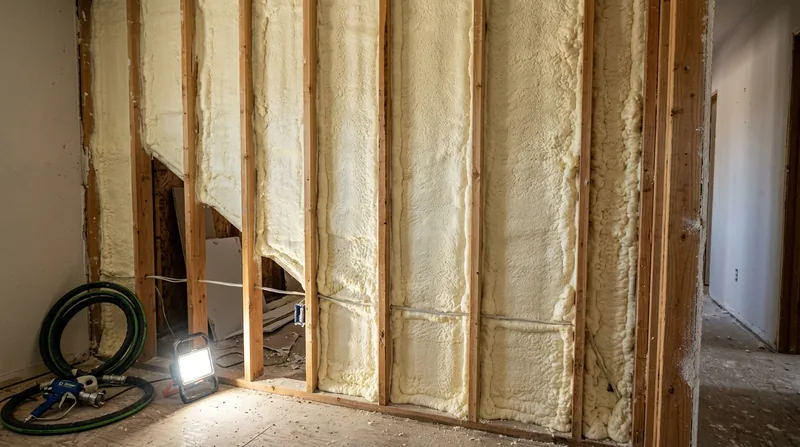




Open cell spray foam insulation in Pueblo fills the gaps that fiberglass batts leave behind in mid-century ranch homes and newer vented attics across Pueblo County. Pueblo sits in a dry, sunny semi-arid climate where the real problem is air leakage, not moisture. Hot summer days and cold winter nights with swings of 40 degrees or more force conditioned air to escape through attic penetrations, rim joists, and wall cavities, then pull outside heat or cold back in. That air exchange drives heating and cooling bills up year after year. Open cell foam expands to seal those gaps, cuts the drafts, and holds its shape across the temperature swings that dominate this region. Unlike closed cell foam, open cell is breathable, lower in density, and costs less per board foot, making it the right choice for many Pueblo attics where moisture is not the limiting factor and budget matters.
Why Open Cell Spray Foam Insulation Matters in Pueblo's Older Homes
Belmont's mid-century ranches and downtown brick homes were built with minimal attic insulation and no air sealing. Decades of settling and flattening have left ceiling planes and top plates full of air leaks. In Pueblo West, newer construction sits on slabs with vented attics and builder-grade batts installed fast during the growth years, but rarely sealed tight enough to stop stack effect and thermal bypass. The Arkansas River valley experiences big day-to-night temperature swings, and every degree of temperature difference pushes air through those gaps. Open cell foam fills stud bays, seals rim joists, and closes attic rafter cavities, cutting the drafts that make your HVAC system run all night.
- Open cell foam expands to fill irregular cavities and gaps that batts cannot reach.
- The material is breathable, so trapped moisture in wall cavities can dry toward the interior or exterior without vapor lock.
- Installation is faster and less expensive than closed cell foam, lowering the total cost of a retrofit.
- R-value per inch runs 3.5 to 4.0, lower than closed cell but sufficient for most Pueblo attic and wall applications.
- The product dampens sound transmission, a bonus in homes near neighbors or near traffic corridors.
These benefits make open cell the practical choice for homeowners ready to seal air leaks without the premium cost of closed cell foam. Visit our attic spray foam insulation page to learn how this approach works in the context of your whole home.
Key info: Pueblo's dry climate means vapor drive is a minor concern compared to straight air leakage. Open cell foam's breathability is an asset, not a liability, in homes where humidity stays low most of the year and the real cost driver is conditioned air escaping through rim joists and attic penetrations.
How We Install Open Cell Spray Foam Insulation in Pueblo
The job starts with a site walk to identify air leak points: rim joists, band joists, attic penetrations around plumbing and electrical, and any existing insulation that has settled or failed. We clear the work area, protect HVAC equipment and ductwork, and set up mechanical ventilation to manage cure odor. Once the substrate is clean and dry, we spray the foam in controlled passes, building thickness to specification without overspraying. The foam expands to fill cavities, then we trim the excess flush with the framing. After cure, typically 24 to 48 hours with ventilation running, the space is ready for occupancy.
- We inspect the attic or wall cavity and identify all air leak pathways before spraying.
- Mechanical ventilation runs during application and cure to manage odor and off-gassing.
- Foam is sprayed in multiple thin passes to achieve uniform density and full cavity fill without voids.
- Excess foam is trimmed flush with the framing so it does not interfere with drywall, flooring, or other finishes.
- We verify R-value and thickness per the specifications you approved in the estimate.
- The home is not re-entered until the stated cure window has passed, typically 24 to 48 hours.
This discipline ensures the foam performs as designed and odor does not linger after the job is done. Learn more about air sealing techniques that complement spray foam and close the gaps fiberglass cannot reach.
Local example: A 1960s ranch in Bessemer with an uninsulated rim joist and a settled attic loses heat all winter through the band joist alone. Open cell foam sealed into the rim cavity and sprayed across the attic floor cuts that heat loss without requiring the home to be vacated for days or weeks.
Open Cell vs. Closed Cell Spray Foam: When to Use Each
| Approach | Description | Best for |
|---|---|---|
| Open Cell Foam | Low-density, semi-rigid foam that expands to fill cavities. R-value 3.5-4.0 per inch. Breathable, allowing vapor to pass through. Lower cost per board foot. | Attics, walls, and rim joists in dry climates. Budget-conscious retrofits. Sound dampening. Homes where moisture control is not the primary concern. |
| Closed Cell Foam | High-density, rigid foam with closed cell structure. R-value 6.0-7.0 per inch. Acts as a vapor barrier. Higher cost per board foot but higher R-value per thickness. | Metal buildings, barndominiums, crawl spaces with moisture risk, sealed attics, and applications where condensation control and structural strength are critical. |
| Blown-In Fiberglass or Cellulose | Loose-fill insulation blown into cavities. Lower cost. No air sealing of small gaps. Settles over time and loses effectiveness. | Top-up of existing sound attic insulation where air leakage is not the primary issue. Not recommended for rim joists, crawl spaces, or walls with known air leaks. |
| Injection Foam Into Closed Walls | Foam injected into wall cavities of existing homes without removing drywall. Fills voids and seals air leaks from inside the wall. | Pre-1980 stock with uninsulated walls. Retrofits where demolition is not an option. Homes in Pueblo where exterior access is limited or where interior finishes must be preserved. |
Pueblo's dry climate and big temperature swings favor open cell foam in most attic and wall applications. Closed cell is reserved for metal buildings, barndominiums, and crawl spaces where condensation or structural load is a factor. Learn more about closed cell spray foam if your project involves moisture control or a sealed attic assembly.
Open Cell Spray Foam Insulation Cost in Pueblo: What to Expect
Open cell spray foam starts at approximately $0.55 per board foot in the Pueblo area, though the total cost depends on several concrete factors. A typical attic retrofit in Pueblo or Pueblo West ranges from $1,500 to $4,500, depending on square footage, ceiling height, the number of penetrations to seal, and whether existing insulation must be removed first. Rim joist and band joist sealing runs $800 to $2,000 per linear application. Wall cavity injection into closed walls of older homes typically costs $1,200 to $3,500 per wall section. The cost per board foot can shift based on job complexity, access difficulty, and whether the substrate requires cleaning or repair before foam is applied.
- Attic square footage is the primary driver: larger attics require more material and more spray time.
- Existing insulation that must be removed adds labor and disposal cost, typically $0.25 to $0.50 per square foot.
- Rim joist and band joist work is priced by linear foot because the cavity is shallow and the labor is concentrated.
- Wall injection into closed cavities requires drilling and patching, adding cost compared to attic spray.
- Access difficulty, such as tight attics or crawl spaces with low headroom, increases labor time and thus total cost.
- Substrate condition matters: if framing is wet, moldy, or requires repair, we walk away and refer you to the appropriate trade before foam is applied.
The best way to understand cost for your home is to request a free estimate. We measure on site, specify R-value and thickness, and provide a written quote with no obligation. Visit our pricing page for a full breakdown of service costs and factors that move the needle on your total investment.
Open Cell Spray Foam Insulation Near Me: What Pueblo Homeowners Should Know Before Hiring
The spray foam market includes rig-and-run crews who show up in an out-of-state trailer, spray a job in an afternoon with no ventilation, promise immediate re-entry, and vanish when the smell will not go away. It also includes national franchises with high overhead and corporate pricing. The local independent contractor is positioned against both, and the differentiator is honest guidance and correct technique. Before you hire any spray foam installer, including us, verify their insurance, ask for references from recent jobs in Pueblo or nearby, and understand what permits and inspections apply at your address.
- Verify that the contractor carries full general liability and property damage insurance, and ask for a certificate of insurance before work begins.
- Request references from at least two recent jobs in Pueblo, Pueblo West, or Fountain, and call them to ask about odor, cure time, and whether the work held up.
- Confirm that mechanical ventilation will run during application and cure, and ask what the re-entry window will be before you move back into the space.
- Understand whether your city or county requires a permit for spray foam insulation, and defer to the local building department, not the contractor, for the final answer.
- If your home is in an HOA with architectural rules, confirm that spray foam work on exterior surfaces or metal structures does not require architectural approval before you book.
- Get a written estimate that specifies R-value per inch, thickness in inches, the total board feet, and the total cost. Avoid any estimate that omits these details.
These steps protect you and ensure the contractor you hire has the skill and insurance to deliver a job that lasts. Contact us at (719) 467-2790 to discuss your project and schedule a free, no-obligation estimate. We have served Pueblo, Pueblo West, Fountain, and surrounding areas since 2013.
Open Cell Spray Foam Insulation in Pueblo: Pricing Guide
| Service | Price | Details |
|---|---|---|
| Open Cell Spray Foam Attic Insulation | Starting at $0.55/board ft | Material and labor to spray open cell foam into attic cavities. Total cost driven by square footage and existing insulation removal needs. |
| Rim Joist and Band Joist Sealing | Starting at $0.55/board ft | Open cell foam sprayed into rim and band joist cavities. Priced by linear foot because cavities are shallow and labor is concentrated. |
| Wall Cavity Injection Foam Retrofit | Starting at $0.55/board ft | Foam injected into closed wall cavities of existing homes without demolition. Includes drilling, injection ports, patching, and foam material. |
| Insulation Removal and Replacement | Starting at $0.25/sq ft removal | Removal of failed, settled, or contaminated insulation before new foam is applied. Disposal and substrate prep included in total estimate. |
| Travel and Estimates | Free estimate, no travel fee | We measure on site, specify R-value and thickness, and provide a written quote. No charge for the estimate or travel within Pueblo and surrounding areas. |
Indicative pricing, the exact cost depends on square footage, finish, and site access. Free personalized estimate within 24h at (719) 467-2790.


