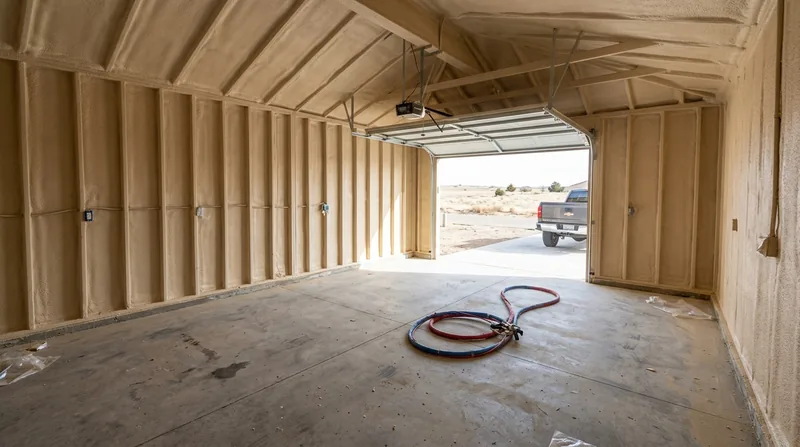




Detached garages and shops around Pueblo swing from icy winter mornings to scorching summer afternoons. A garage spray foam insulation job tightens the building envelope, keeping tools, vehicles and workspace more comfortable year-round while cutting the strain on heating and cooling. Pueblo's dry climate and big day-to-night temperature swings put real stress on an uninsulated garage wall or ceiling, and conditioned air leaks out through every seam, stud cavity and rim joist connection. We spray foam across garage walls, ceilings and band joists to seal those air leaks at the source. Unlike batts or loose-fill, foam fills every cavity and adheres to framing, stopping stack effect and infiltration cold. Whether you're in Pueblo proper, Pueblo West, Fountain or any of the surrounding areas, we handle the full scope: closed cell for maximum R-value in tight spaces, open cell for sound dampening and cost efficiency, and air sealing to lock down the whole assembly.
Why Garage Spray Foam Insulation Matters in Pueblo's Temperature Swings
Pueblo sits in a semi-arid climate where summer days hit 90 degrees and winter nights drop into the teens, often within the same 24 hours. A detached garage with no insulation becomes a thermal sieve: in winter, conditioned air escapes through every unsealed cavity and rim joist, and outside cold pours back in. In summer, the metal roof and uninsulated walls absorb heat all day and radiate it into the space all night. That air exchange, not moisture, is what drives real comfort loss and energy waste across Pueblo County. Spray foam stops infiltration and exfiltration by sealing the entire assembly at once, not just laying blankets over top of leaks.
- We seal garage walls from top plate to rim joist, eliminating the stack effect that pulls cold air in at the bottom and pushes warm air out at the top.
- We insulate garage ceilings to block radiant heat gain in summer and heat loss in winter, especially critical in Pueblo where the sun is intense and nights are cold.
- We air-seal all rim and band joist connections where the garage frame meets the foundation, the single biggest leak point in older and newer construction alike.
- We spray over garage door headers and wall penetrations that builder-grade construction leaves wide open.
A properly sealed garage keeps the interior temperature much closer to conditioned space, making the area usable year-round and reducing the load on your home's HVAC system.
Local example: A Pueblo homeowner with a detached two-car garage in the Belmont area had an uninsulated structure with a vented attic and exposed rim joists. Winter mornings were 20 degrees colder than the house; summer afternoons were unbearable. After we sprayed closed cell foam across the ceiling and walls and sealed the rim joist, the garage stayed within 10 degrees of the house year-round, and the space became a usable workshop in winter.
Colorado allows spray foam insulation on residential structures and does require compliance with energy and building code at your address. The building official in Pueblo, Pueblo West, or your municipality governs thermal barrier and ignition barrier requirements, and permits are handled at the local level. We help you navigate what applies to your address and work with your building department. For more on how these rules affect your insulation choices, see our air sealing service page.
How We Spray Foam a Garage in Pueblo: The Process
Every garage is different. A detached one-car shop in Penrose sits on a different foundation and faces different exposures than a two-car garage attached to a home in Pueblo West. We start with an on-site estimate where we measure the space, identify all air leaks and thermal weak spots, and recommend the foam type and thickness that fits your budget and performance goals. We'll specify R-value and board feet so you know exactly what you're paying for. Then we schedule the spray, control the temperature and humidity during application, and allow the foam to cure before re-entry.
- We conduct a free on-site estimate, measuring the garage and identifying rim joists, headers, wall cavities and ceiling penetrations that need sealing.
- We recommend closed cell or open cell foam based on your R-value target, budget and the specific use of the space (tool storage, vehicle parking, workshop).
- We prepare the space, set up mechanical ventilation to manage off-gassing during cure, and establish a re-entry window of 24 to 48 hours.
- We spray foam in controlled passes, maintaining proper drum temperature and manufacturer ratio to ensure full expansion and adhesion.
- We trim excess foam flush with the framing and allow cure time before the space is occupied or finished.
The entire job typically takes one to three days depending on garage size and complexity, with the cure period extending another 24 to 48 hours before you can use the space normally.
Example from Pueblo West: A newer construction two-car garage with a vented attic and builder-grade fiberglass batts in the ceiling had significant air leaks around the garage door header and rim joist. We sprayed 2 inches of closed cell foam across the entire ceiling, sealed the header and the rim joist connection, and brought the attic cavity to R-20 equivalent, eliminating the temperature swing between the garage and the house.
For more details on the difference between closed cell and open cell foam, see our closed cell spray foam page and open cell spray foam page.
Garage Spray Foam Methods and Approaches
| Approach | Description | Best for |
|---|---|---|
| Closed Cell Spray Foam | High-density foam with tight cell structure, R-value of 6 to 7 per inch, vapor barrier properties, and excellent adhesion to wood and metal framing. | Garage ceilings and walls where maximum R-value in thin space is needed; metal building roofs and rim joists where condensation control matters. |
| Open Cell Spray Foam | Lower-density foam with open cell structure, R-value of 3.5 to 4 per inch, moisture-permeable, and excellent for sound dampening. | Garage interiors where cost efficiency and sound control are priorities; walls and ceilings where vapor permeability is acceptable. |
| Rim and Band Joist Sealing | Targeted spray foam application to the perimeter where garage frame meets foundation, stopping infiltration and thermal bridging at the most critical leak point. | All garages, especially those in Pueblo with older foundations or new construction with builder-grade rim board and minimal sealing. |
| Garage Door Header and Wall Penetration Sealing | Foam application around garage door openings, electrical boxes, HVAC penetrations and other cavities left unsealed during framing. | Garages where air leakage around the door frame and wall penetrations is visible (drafts, temperature swings) or where a complete thermal envelope is the goal. |
Garage Spray Foam Insulation Cost in Pueblo: What to Expect
Garage spray foam insulation in Pueblo typically starts at $1,200 for a small single-car structure with straightforward wall and ceiling coverage. The final cost depends on several concrete factors: the size of the garage (square footage of walls and ceiling), the type of foam (closed cell costs more per board foot but delivers higher R-value; open cell is less expensive and still effective for many applications), the existing condition of the space (clean framing costs less than removing old insulation first), and the accessibility of walls and ceilings. A two-car garage with a full ceiling and rim joist sealing usually runs between $2,500 and $4,500. A detached shop or metal building with steel framing and larger square footage may run higher. The best way to know your actual cost is to get a free on-site estimate from us, and then get one or two more from other local contractors so you can compare specifications, not just price.
When you call for an estimate, we measure the space and tell you the R-value and board feet we recommend. We also explain what factors will move the price up or down so you understand the trade-offs. For a detailed pricing overview across all our services, visit our pricing page.
What to Look for When Hiring a Spray Foam Insulation Contractor Near Pueblo
Spray foam insulation is a technical trade, and the difference between a careful, professional installation and a rushed or poorly executed one shows up in comfort, durability and cost. When you are evaluating contractors near Pueblo, Pueblo West, Fountain or any surrounding area, focus on how they work and what they promise, not just the price. A good contractor will give you a written estimate with R-value and thickness specified, will explain the cure time and re-entry window clearly, and will be reachable after the job is done if you have questions. A bad contractor will give you a vague price, promise immediate re-entry, and disappear once the invoice is paid. Here's what to verify:
- Ask to see proof of liability insurance and verify the coverage limits with the insurance company, not just the contractor's word.
- Request references from at least two recent garage or attic spray foam jobs in Pueblo or nearby, and call them to ask about the installation quality and the contractor's responsiveness afterward.
- Get the estimate in writing with the R-value per inch, the total board feet, the thickness in each area, and the foam type clearly named (closed cell or open cell).
- Ask what permits apply to your address and whether the contractor will help you navigate the local building department, or whether you are responsible for pulling permits yourself.
- Verify that the contractor will provide mechanical ventilation during cure and will specify a realistic re-entry window of 24 to 48 hours, not promise you can use the space immediately.
- Check whether the contractor is reachable by phone or email after the job is complete if you have questions about cure time, odor, or performance.
For more information on getting a free estimate and scheduling your garage spray foam insulation, contact us today or call (719) 467-2790.
Garage Spray Foam Insulation in Pueblo: Pricing Guide
| Service | Price | Details |
|---|---|---|
| Single-car garage ceiling and walls | Starting at $1,200 | Closed cell foam, 2 inches, basic rim joist sealing, up to 400 square feet |
| Two-car garage with full insulation | Starting at $2,500 | Closed cell or open cell foam, 2 to 3 inches ceiling and walls, complete rim joist sealing |
| Detached shop or metal building | Starting at $3,000 | Closed cell foam for condensation control, steel framing sealing, larger square footage and height |
| Rim joist and band joist sealing only | Starting at $600 | Targeted foam application to perimeter, no ceiling or wall work, entry-level air sealing |
| Insulation removal before spray foam | On estimate | Costs depend on existing insulation type, volume and disposal; quoted separately from new foam |
| Free estimate | No charge | On-site measurement, R-value recommendation, written specification, response within 24 hours |
Indicative pricing, the exact cost depends on square footage, finish, and site access. Free personalized estimate within 24h at (719) 467-2790.


