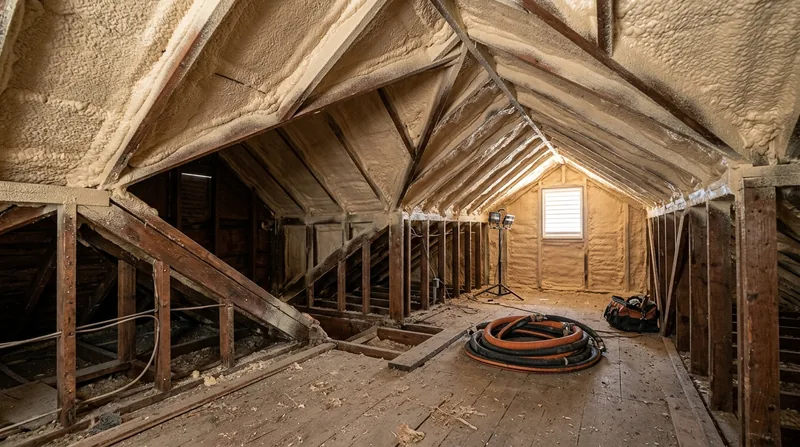




Insulation Replacement & Re-Insulation in Pueblo is the practical answer to aging, failed, or settled insulation that no longer holds back the heat and cold swings that dominate this region. Pueblo sits in a dry, sunny semi-arid climate along the Arkansas River where summers are hot and winters bring cold nights with dramatic day-to-night temperature swings. Older homes in Bessemer, Mesa Junction, and around downtown often carry original attic insulation that has settled flat over decades, leaving ceiling planes and top plates full of air leaks. Mid-century ranches in Belmont and newer construction in Pueblo West both suffer from the same problem: conditioned air escapes through attic penetrations, rim joists, and wall cavities, and outside heat or cold pours back in. That air exchange, not moisture, is what drives high bills across Pueblo County. We remove failed insulation and install new spray foam sized to your space, closing the gaps that older fiberglass batts and blown-in cellulose never sealed tight enough to stop.
Why Insulation Replacement & Re-Insulation Matters in Pueblo's Hot-to-Cold Climate
Pueblo's temperature swings put more strain on a home's air barrier than almost any other factor. A summer day can reach the high 80s or 90s, then drop 30 degrees at night. Winter highs hover in the 40s while nighttime lows plunge well below freezing. That constant cycling forces conditioned air out and outside air in through every unsealed gap. Settled fiberglass batts and older cellulose blow-in do not seal; they only slow convection. When insulation fails or never sealed properly in the first place, your HVAC runs harder and longer, and your bills climb every season.
- Settled attic insulation loses R-value and creates thermal bypasses where air moves freely around batts and into conditioned spaces.
- Rim joists and band joists in older Pueblo basements and crawl spaces are often uninsulated or wrapped in paper-faced batts that deteriorate and gap over time.
- Wall cavities in pre-1980 stock homes may have no insulation at all, or insulation that has shifted and compacted, leaving voids that pull conditioned air through exterior walls.
- Vented attics in newer Pueblo West construction allow outside air to flow freely across the top plates and through penetrations, negating whatever insulation sits above.
Replacing failed insulation with spray foam closes these gaps completely, restoring the air barrier and stopping the cycle of heat loss and gain that makes your cooling and heating systems work overtime.
Key info: Pueblo's low humidity most of the year means vapor drive is a minor concern compared to air leakage. Straight air sealing, not moisture control, is what stops high bills in Bessemer, Mesa Junction, Belmont, and Pueblo West. See the Colorado Building Code and your local building department for ventilation and thermal barrier rules that apply to your address.
How We Handle Insulation Replacement & Re-Insulation in Pueblo Homes
Replacement insulation starts with removal of failed material. We assess what is in place, pull it out safely, and dispose of it responsibly. Once the cavity is clean, we measure the space and choose the right foam type and thickness for your climate and use. For most Pueblo attics, closed cell spray foam delivers the R-value and air seal needed to stop the heat and cold swings. For walls and rim joists, we often use injection foam to retrofit existing cavities without tearing into drywall. Open cell foam is the choice when sound dampening matters and R-value per inch is less critical. We install to the thickness and density your space requires, apply thermal and ignition barriers per code, and leave mechanical ventilation running during cure to manage off-gassing. Re-entry is safe within 24 to 48 hours.
- We visit your home to inspect the existing insulation, measure the cavity, and identify air leaks and thermal bypasses.
- We provide a written estimate with R-value, thickness, and foam type specified for your space and the local code.
- We remove old insulation, clean the cavity, and seal any gaps or cracks in the substrate before spraying.
- We spray foam at the correct ratio, temperature, and thickness, applying it in passes to avoid over-packing and poor density.
- We trim excess foam, install thermal and ignition barriers, and set up mechanical ventilation for the cure period.
- We walk you through the re-entry window and post-cure care, and stand behind the workmanship for one to three years.
This step-by-step approach ensures the new insulation performs as designed and seals the air leaks that drove your bills up in the first place.
Real example: A Bessemer-area home with a 1970s attic of settled fiberglass and a 1980s rim joist wrapped in paper-faced batts had high winter heating bills and cold floors. We removed both, sprayed closed cell foam in the attic to R-30, and sealed the rim joist to R-20 with injection foam. The homeowner reported lower bills and no more cold spots within the first heating season. See our Insulation Removal page for more on the tear-out process.
Insulation Replacement & Re-Insulation Methods and Materials
| Approach | Description | Best for |
|---|---|---|
| Closed Cell Spray Foam | High-density foam that seals completely and delivers R-6 to R-7 per inch. Rigid, air-impermeable, and ideal for controlling air leakage in Pueblo's temperature swings. | Attics, sealed roof decks, rim joists, walls, and any space where air sealing is the priority. |
| Open Cell Spray Foam | Lower-density foam that delivers R-3.5 to R-4 per inch, breathes slightly, and absorbs sound. Less expensive than closed cell and suitable for vented attics and interior applications. | Attics with existing ventilation, interior walls, and projects where cost is a factor and R-value per inch is not the sole driver. |
| Injection Foam (Wall Cavities) | Low-pressure closed cell foam injected into existing wall cavities without demolition. Fills voids completely and seals air leaks in pre-1980 homes. | Retrofitting exterior walls in older Pueblo homes, rim joists, and band joists where opening the wall is not an option. |
| Removal and Replacement | Complete tear-out of old fiberglass, cellulose, or failed foam, followed by cavity cleaning and new foam installation. Handles settled batts, deteriorated paper-faced insulation, and asbestos-risk materials. | Any attic or wall with failed or inadequate insulation where starting fresh with a clean cavity is the best path to a lasting seal. |
Each method targets a specific problem in Pueblo homes. Closed cell is the workhorse for attics and rim joists where air sealing matters most. Open cell is the budget-conscious choice for vented spaces. Injection foam solves the retrofit puzzle in walls without tearing into drywall. Removal and replacement is the foundation of every re-insulation job, because a clean cavity and a proper substrate are non-negotiable.
Insulation Replacement & Re-Insulation Cost in Pueblo: What to Expect
Spray foam insulation replacement in Pueblo starts at $2,800 for a small attic or a single rim joist, and scales with the size and complexity of the job. A full attic re-insulation in a typical Pueblo home often runs $4,500 to $8,000 depending on square footage, existing material, and whether injection foam or full spray is needed. Wall retrofits and crawl space sealing are priced per board foot of foam installed, which is measured on site and varies by cavity size and depth. The biggest cost drivers are the area to be insulated, the height and access difficulty, the type of foam chosen, and whether removal and disposal of old insulation is included.
- Attic insulation replacement with closed cell foam runs higher per square foot than open cell, but delivers better R-value and air sealing in Pueblo's climate.
- Rim joist and band joist sealing is often a smaller ticket, $800 to $2,000 per run, and is one of the highest-return improvements in older homes.
- Wall injection foam for a 1,500-square-foot home exterior can range $3,000 to $6,000 depending on wall height and cavity depth.
- Removal and disposal of old insulation adds $500 to $2,000 depending on volume and whether asbestos-risk material like vermiculite is present and requires professional testing.
- Travel and setup are included in the estimate; there is no separate mileage or mobilization fee for jobs in Pueblo and surrounding areas.
Getting 2 to 3 written estimates from qualified contractors is the smart move. Each estimate should list R-value, thickness, foam type, and what is and is not included in the price. See our pricing page for more detail on what drives costs up and down, and call (719) 467-2790 for a free estimate with no obligation.
What to Look for When Hiring an Insulation Replacement Contractor Near Pueblo
The spray foam trade has rig-and-run crews, national franchises, and local independents. The rig-and-run operator arrives in an out-of-state trailer, sprays a job in an afternoon, and is unreachable when the smell will not go away or the foam did not cure right. The national franchise charges top dollar and subcontracts to whoever is available. A local contractor with a local address and local plates has skin in the game: reputation matters, and you can reach someone when something goes wrong. Before you hire, verify that the contractor is fully insured and can show a current certificate of insurance. Ask for references from recent jobs in Pueblo or nearby areas and follow up with at least two. Get a written estimate with R-value, thickness, and foam type specified, not a vague price per square foot. Understand that permits and building code rules vary by city across Greater Pueblo, and the contractor should defer to your local building department on ventilation, thermal barriers, and ignition barriers. Ask how they will manage off-gassing during cure and what re-entry window they guarantee. Avoid any contractor who promises immediate re-entry, skips mechanical ventilation, or cannot explain the ratio and temperature of the foam they use.
- Check that the contractor carries general liability and workers compensation insurance and provides a copy before work begins.
- Ask for at least two references from Pueblo-area jobs completed in the past 12 months and call them to ask about quality, cleanliness, and follow-up.
- Request a written estimate that specifies R-value, foam thickness in inches, closed cell or open cell, and all labor and material included.
- Confirm that the contractor understands the local code for your address and will work with your city or county building department on permits and inspections.
- Ask how the contractor manages odor and off-gassing, whether mechanical ventilation will run during cure, and what re-entry window is guaranteed (typically 24 to 48 hours).
- Avoid any estimate with no R-value or thickness, a price far below market, promises of immediate re-entry, or insurance that cannot be verified.
The strongest signal of a competent contractor is a clear, detailed estimate and a willingness to walk away from a job if the substrate is wet, contaminated, or leaking. Spray foam does not fix a roof leak or standing water in a crawl space; it seals the air leaks in a dry, sound cavity. A contractor who says "we fix the moisture first or we walk away" is one you can trust. Contact us at our contact page or call (719) 467-2790 to schedule a free estimate and see how we compare.
Insulation Replacement & Re-Insulation in Pueblo: Pricing Guide
| Service | Price | Details |
|---|---|---|
| Small attic or rim joist | Starting at $2,800 | Removal of old insulation, closed cell spray foam to R-20 or R-24, sealing and thermal barrier included |
| Full attic replacement (typical Pueblo home) | Starting at $4,500 | 1,000 to 1,500 sq ft, removal, closed cell foam to R-30, all labor and barriers, varies by access and existing material |
| Wall injection foam retrofit (exterior walls) | Starting at $3,000 | 1,500 sq ft home, low-pressure injection foam in existing cavities without demolition, removal of failed insulation if present |
| Crawl space or rim joist sealing | Starting at $1,200 | Band joist and rim perimeter, closed cell foam to R-20, vapor barrier and mechanical ventilation during cure included |
| Large or complex job | On estimate | Multi-zone projects, asbestos-risk removal, wet or contaminated cavities, or commercial spaces require on-site inspection |
| Free estimate | No charge | Response within 24 hours at (719) 467-2790, written quote with R-value and thickness, no obligation to book |
Indicative pricing, the exact cost depends on square footage, finish, and site access. Free personalized estimate within 24h at (719) 467-2790.


