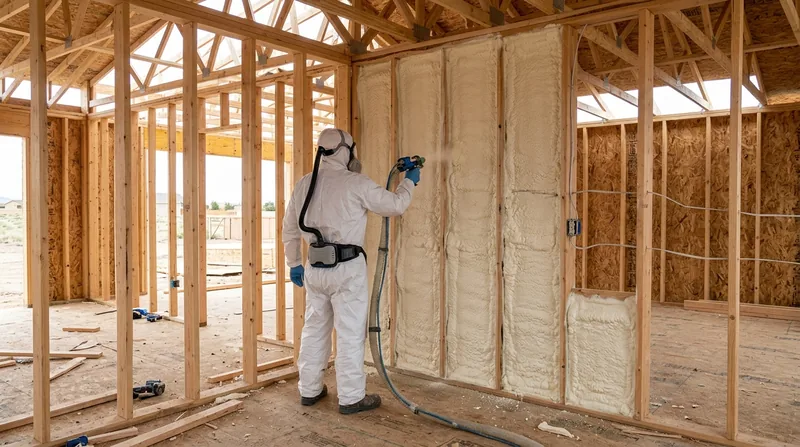




Commercial and new construction spray foam insulation in Pueblo is the air-sealing step that happens before drywall, before the building inspector signs off, and before conditioned air starts leaking away through every unsealed rim joist, top plate, and mechanical penetration. Pueblo West has grown fast over the past decade, and most of that new construction sits on concrete slabs with vented attics and builder-grade batts that were never meant to stop the hot-to-cold swings this region sees every day. In the dry, high-altitude climate along the Arkansas River, air leakage, not moisture, is what drives heating and cooling costs. When you seal the thermal envelope with spray foam before the walls close up, you lock in efficiency from day one and avoid the retrofit cost and disruption that comes later. We work with builders and commercial contractors across Pueblo, Pueblo West, and Fremont County to spray foam before final inspection, ensuring the building meets code and performs as designed. Call (719) 467-2790 for a free commercial estimate with R-value and thickness specs.
Why New Construction Spray Foam Sealing Matters in Pueblo's Climate
Pueblo's semi-arid climate creates extreme day-to-night temperature swings, especially in winter and early spring. A new home or commercial building with a loose air barrier will leak conditioned air through the rim joist, around electrical and plumbing penetrations, and up through the attic even before occupancy. The builder-grade approach of batts plus a vented attic worked in older construction because there was less expectation of efficiency. Today's energy codes and homeowner expectations demand a sealed thermal envelope, and that envelope is only as good as the air barrier installed before drywall covers it. Spray foam applied at the rim, band joist, top plates, and around mechanical chases creates a continuous barrier that batts cannot match.
- Seal the rim joist and band joist before the rim board is covered, stopping the stack-effect air leakage that dominates heating bills in Pueblo's cold nights.
- Spray foam around electrical boxes, HVAC penetrations, and plumbing chases during rough-in, before insulation inspection, so the thermal envelope is complete.
- Apply closed cell or open cell foam to the underside of the roof deck in new construction to create an unvented attic, eliminating moisture concerns and gaining attic space.
- Achieve R-value and thickness specs required by current energy code, with documentation for the building inspector.
Getting this right on new construction is far cheaper than tearing out failed insulation and re-spraying five years later.
Local example: A new spec home in Pueblo West built with a vented attic and batt insulation will lose 15 to 25 percent of its heating load through the rim joist alone if it is not sealed. Spray foam at the rim during framing costs far less than adding a blown-in blanket retrofit later, and it eliminates the air leakage that batts cannot stop.
For more on how air sealing works in residential and commercial settings, see our air sealing service page.
How We Approach Commercial and New Construction Spray Foam in Pueblo
Our process starts with a walk-through during the framing stage, before electrical rough-in if possible. We identify all rim joists, band joists, top plates, and mechanical penetrations that need sealing. We provide a written estimate with R-value, thickness, and board-foot specs so you and the builder know exactly what will be sprayed and where. We coordinate with the general contractor and the building inspector to make sure the work fits the schedule and meets code.
- Walk the building during framing to identify rim joists, band joists, top plates, mechanical chases, and roof deck areas that need foam.
- Provide a written estimate specifying R-value, thickness in inches, and total board feet for each section.
- Confirm the spray date and coordinate with the builder's schedule so foam is applied before insulation inspection.
- Spray closed cell or open cell foam as specified, maintaining proper drum temperature and mix ratio throughout.
- Provide mechanical ventilation during cure and document the re-entry window (24 to 48 hours) on the work ticket.
- Leave the site clean and provide photos and thickness documentation for the building file.
This disciplined approach means the building passes inspection on time and the thermal envelope performs as designed from day one.
Example: A commercial shell in Pueblo scheduled for spring occupancy can have its rim joist and roof deck sealed in a single day if the work is planned during framing. The builder avoids a retrofit call-back and the tenant gets a building that meets energy code.
For details on how closed cell spray foam performs in high-temperature commercial applications, see our closed cell service page.
Commercial and New Construction Spray Foam Methods
| Approach | Description | Best for |
|---|---|---|
| Closed Cell Foam at Rim and Band Joist | High-density foam (3.5 to 3.6 lb/cf) sprayed 1 to 2 inches thick on the rim joist, band board, and band joist. R-value 6 to 6.5 per inch. Forms a continuous air barrier and moisture barrier. | New construction in Pueblo West where the rim sits on a concrete stem wall and must stop both air and any incidental moisture. |
| Closed Cell Foam Under Roof Deck (Unvented Attic) | Closed cell sprayed 2 to 3 inches thick on the underside of the roof sheathing, creating an unvented attic with high R-value and no ventilation fans required. | New construction where the attic will be conditioned space or where the builder wants maximum R-value and zero moisture risk. |
| Open Cell Foam in Attics (Vented) | Lower-density foam (0.5 to 0.6 lb/cf) sprayed 5 to 7 inches thick on the underside of the roof deck in a vented attic. R-value 3.5 to 3.8 per inch. Permeable to vapor. | New construction where the attic is vented and cost is a concern, or where the builder prefers a softer, sound-dampening insulation. |
| Closed Cell Around Mechanical Penetrations | Closed cell sprayed around electrical boxes, HVAC ducts, plumbing chases, and other rough-in penetrations to seal air leaks before drywall goes up. | Commercial and multi-family new construction where airtightness and code compliance are non-negotiable. |
Commercial and New Construction Spray Foam Cost in Pueblo: What to Expect
The cost of spray foam sealing on a new commercial or residential building depends on the total linear feet of rim joist, the square footage of roof deck to be sprayed, the type of foam (closed cell or open cell), and the thickness required by your energy code and building design. Rim joist sealing on a typical new home foundation in Pueblo West might run from $800 to $2,500 depending on the perimeter and access. A new commercial shell with roof deck foam and mechanical sealing can range from $3,000 to $15,000 or more. The best way to know is to call for a free commercial estimate. We come to the site during framing, measure, and provide a written quote with R-value and thickness specs so there are no surprises.
Several factors move the cost up or down. A building with difficult rim access, tight corners, or complex mechanical layouts takes longer and costs more. A large building with extensive roof deck area will cost more in total but may have a lower per-board-foot rate. If the building is scheduled for an early inspection and you need the work done in a narrow window, that affects timing but not our price. Travel is included within Pueblo and surrounding areas; there is no separate mileage charge.
The key is to get the foam spray done during framing, before drywall, so it does not become a retrofit. A retrofit of an already-closed building costs significantly more because walls must be opened, insulation removed, and the building occupied during the work. New construction is the time to seal right, and the cost is built into the construction budget where it belongs.
For a detailed breakdown of what affects pricing across all our services, see our pricing page.
What to Look for When Hiring a Spray Foam Contractor Near Pueblo
Hiring the right spray foam contractor for your new construction project is one of the most important decisions you will make, because the work is hidden behind drywall and cannot be easily inspected or redone without major cost. The market includes local independent shops, national franchises, and out-of-state crews that show up, spray fast, and disappear. Here is what to verify before you sign.
- Confirm the contractor is fully insured with general liability and workers compensation, and ask to see the certificate.
- Request a written estimate that specifies R-value, thickness in inches, and total board feet for each section of the building.
- Ask whether the contractor will provide mechanical ventilation during cure and confirm the re-entry window in writing.
- Verify that the contractor understands your local building code and can explain how the work meets it, then check with your building department to confirm.
- Get references from recent commercial or new construction projects and call them to ask about quality, timeliness, and whether the building passed inspection on the first try.
- Avoid any contractor who promises a price far below market, offers immediate re-entry after spraying, or cannot provide a clear estimate with thickness and R-value.
A reputable local contractor will answer these questions clearly, provide documentation, and stand behind the work with a reasonable warranty on installation quality.
If you have questions about our insurance, process, or references, call (719) 467-2790 to request a free estimate and speak with someone who knows your project.
Commercial & New Construction Spray Foam in Pueblo: Pricing Guide
| Service | Price | Details |
|---|---|---|
| Free Commercial Estimate | Free | On-site walk-through during framing with written specs for R-value, thickness, and total board feet |
| Rim and Band Joist Sealing (Typical Home) | Starting at $800 | Closed cell foam around perimeter rim joist, varies by foundation size and access difficulty |
| Roof Deck Foam (Residential Attic) | Starting at $1,200 | Closed or open cell foam under roof sheathing, depends on square footage and foam type selected |
| Commercial Shell or Multi-Building Project | On Estimate | Scope and cost determined by site walk, mechanical layout, roof deck area, and energy code requirements |
| Travel and Coordination | Included | No separate mileage charge within Pueblo and surrounding service areas; scheduling coordinated with builder timeline |
| Estimate Response | Free | Written estimate within 24 hours with no obligation; call (719) 467-2790 to schedule walk-through |
Indicative pricing, the exact cost depends on square footage, finish, and site access. Free personalized estimate within 24h at (719) 467-2790.


