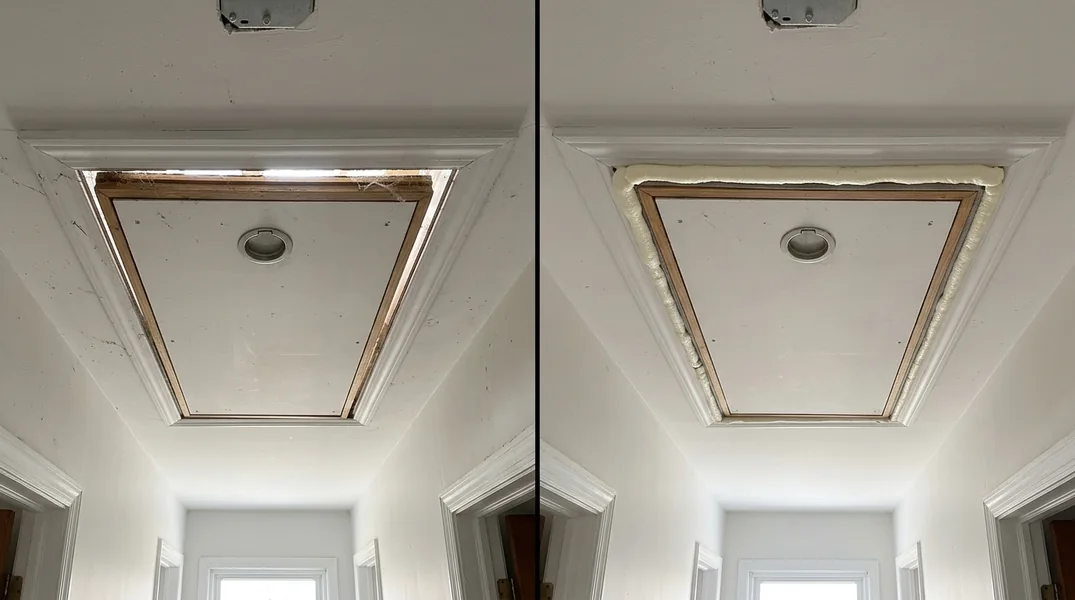
Understanding Your Attic Insulation Options in Pueblo
If you own a home in Pueblo, chances are your attic insulation is either outdated, unevenly distributed, or simply not performing as well as it once did. When you start researching solutions, you'll encounter two main paths: air sealing combined with adding insulation on top of what's already there, or a complete tearout and replacement with Attic Spray Foam Insulation. Both approaches have merit, and the right choice depends on your home's current condition, your budget, and your long-term energy goals.
The decision isn't always straightforward, which is why many homeowners feel stuck between these options. Air sealing is often the more affordable starting point and can deliver surprising energy savings when done correctly. However, spray foam insulation offers superior performance and a permanent solution that addresses air leaks and insulation in one step. Understanding the differences between these approaches will help you make an informed decision that works for your specific situation.
What Is Air Sealing and When Does It Make Sense?
Air sealing is the process of identifying and closing gaps, cracks, and penetrations in your attic that allow conditioned air to escape. These leaks often occur around ductwork, electrical outlets, pipe penetrations, and the rim joists where your attic meets the walls below. A professional air sealing job involves using caulk, weatherstripping, foam closure, and other materials to plug these gaps before adding any new insulation on top of existing material.
This approach makes the most sense if your current insulation is relatively uniform, not heavily contaminated, and your attic doesn't have structural damage or moisture problems. Air sealing alone can reduce energy loss by 10 to 20 percent, and when combined with topping up insulation to meet Pueblo area standards, it often proves cost-effective for homeowners on a tighter budget. The beauty of air sealing is that it's non-invasive, relatively quick, and you don't have to deal with the mess and complexity of removing old insulation. If your attic already has decent coverage and you're mainly concerned about air infiltration, this incremental approach might be exactly what you need.
Spray Foam Insulation R Value Per Inch and Why It Matters
One of the biggest advantages of Closed Cell Spray Foam Insulation is its exceptional R-value per inch. Closed cell foam delivers approximately 6.0 to 6.5 R-value per inch, while Open Cell Spray Foam Insulation provides around 3.5 to 3.6 R-value per inch. Compare this to traditional fiberglass batts at roughly 3.2 to 3.8 R-value per inch, and you'll see why spray foam is considered the premium option for attic insulation.
This higher R-value density means you achieve better insulation performance in a thinner application, which is especially valuable in attics with limited headroom or complex framing. If your goal is to maximize insulation performance without adding excessive thickness, spray foam is the clear winner. However, this superior performance comes at a higher upfront cost, which is why understanding your specific R-value requirements is essential before deciding whether the investment makes sense for your home.
R Value Requirements by State and What Pueblo Homeowners Need to Know
Colorado, the state where Pueblo is located, recommends attic insulation R-values between R-38 and R-60 depending on your heating and cooling system and climate zone. Pueblo falls into a moderate climate zone, which typically calls for R-38 to R-49 for optimal energy efficiency. If your current insulation falls short of these targets, you're losing money on every heating and cooling bill during Colorado's long winters and hot summers.
The key takeaway is that meeting your state's R-value requirements isn't just about comfort; it directly impacts your home's resale value and your eligibility for energy efficiency rebates and tax credits. If your attic currently has only R-19 or R-25, you have a significant gap to close. Air sealing combined with adding batts or blown-in insulation might get you partway there, but full spray foam application guarantees you'll meet or exceed requirements in a single, comprehensive application. When you're comparing options, always factor in whether your chosen solution will actually achieve the R-value target your home needs.
Attic Spray Foam Insulation Cost in Pueblo: What to Budget
The pricing for attic spray foam insulation typically ranges from $1.50 to $3.00 per board foot, depending on the type of foam, the complexity of your attic, and current market conditions. For an average 1,500 square foot attic, you're looking at an investment between $3,000 and $7,000 for a complete spray foam application. Air sealing combined with blown-in insulation generally costs $1,500 to $3,500 for the same space, making it the more budget-friendly option upfront.
However, don't let the initial cost difference be your only deciding factor. Spray foam provides superior air sealing, better long-term performance, and often qualifies for higher insulation tax credits and rebates. Many Colorado homeowners find that the energy savings from spray foam pay for the difference within 5 to 7 years, especially in older homes with significant air leakage. To understand your true financial picture, including any available incentives, contact Pueblo Spray Foam Insulation at (719) 467-2790 for a free estimate tailored to your specific situation.
Insulation Tax Credit and Rebates: Making Your Upgrade More Affordable
The federal government and many Colorado utilities offer insulation tax credits and rebates to encourage homeowners to upgrade their energy efficiency. The federal Energy Tax Credit can cover up to 30 percent of qualifying insulation and air sealing costs, with certain caps per year. Additionally, many Colorado utility companies offer rebate programs that can reduce your out-of-pocket expense by $500 to $2,000 or more, depending on your current insulation level and the improvements you make.
Both air sealing and spray foam insulation can qualify for these incentives, though spray foam often qualifies for larger rebates due to its superior performance. Before deciding between the two approaches, research what your local utility offers and confirm which insulation methods qualify. These financial incentives can dramatically shift the cost-benefit analysis in favor of spray foam, especially if your utility offers substantial rebates for closed cell applications. When you reach out to Pueblo Spray Foam Insulation for your free estimate, ask about current rebate programs and tax credits you may qualify for. We can help you navigate the paperwork and ensure you capture every available incentive.
How Thick Should Spray Foam Be for Optimal Performance?
The ideal thickness for spray foam insulation depends on your target R-value and the type of foam you choose. For closed cell spray foam, achieving R-38 requires approximately 6 to 6.5 inches of application, while R-49 requires about 8 inches. Open cell foam requires roughly 10 to 11 inches to reach R-38 and 13 to 14 inches for R-49. These thicknesses ensure complete coverage and eliminate the thin spots that plague traditional insulation installations.
One major advantage of spray foam is that it conforms perfectly to every surface, filling gaps around rafters, joists, and irregular framing that batts and blown-in insulation simply cannot address. This means you're not just meeting your R-value target on paper; you're actually achieving it in practice. When air sealing and topping up existing insulation, it's much harder to ensure uniform thickness, especially if your existing insulation is already compressed or settled. If you're unsure what thickness and type of foam would work best for your attic, our team at Pueblo Spray Foam Insulation can assess your space and recommend the optimal solution during your free estimate.
Making Your Decision: Top Up or Full Spray Foam Replacement?
Here's the honest truth: if your attic insulation is already in good condition, relatively uniform, and relatively clean, air sealing combined with adding insulation on top can deliver solid results at a lower cost. This approach works well for homeowners who want incremental improvements and have limited budgets. However, if your insulation is old, compressed, contaminated, or unevenly distributed, or if you want a permanent solution that requires no future maintenance, spray foam replacement is the superior choice despite the higher initial investment.
Consider also your long-term plans. If you're planning to stay in your Pueblo home for many years, the energy savings and comfort improvements from spray foam will compound over time. If you're thinking of selling within the next few years, air sealing combined with topping up insulation may provide adequate value without the premium cost. The best way to determine which approach makes sense for your specific situation is to get a professional assessment. Contact Pueblo Spray Foam Insulation at (719) 467-2790 today, and we'll evaluate your attic, discuss both options, and help you make the decision that delivers the best return on your investment.
Looking for a professional spray foam insulation contractor in Pueblo? Pueblo Spray Foam Insulation responds fast for all your spray foam insulation needs.
Get a Free Quote